4.30.2009

Who Cares.


I preached to the choir yesterday. A gang of staffers from the USGBC, already card-carrying converts to green, came for a tour of Green Community yesterday and I struggled to think of what to offer them that they didn’t already know. Almost to a person they were extremely young, at least to my presbyopic eyes. So while I always emphasize that we are not the first generation to face the issue of living cooperatively with Mother Nature, for them personally it is a first.
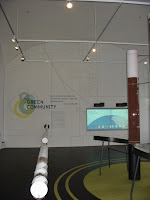
The time-tube in the exhibition tends to sort visitors by age. People will tend to collect at those dates that mean something to them personally. Those of a certain age will inevitably pause at the early 70’s gas crisis and Carter’s installation of solar panels on the White House. Slightly grayer ones will pause in the early 60’s with Rachel Carson. The 20-somethings may have only a vague memory of the Exxon Valdez and probably think that ISTEA is a cold drink. USGBC’s LEED rating system is just over 10 years old. Young people, working for a young organization, on a young idea...with a very, very old context.

As I led the group through, pausing at whatever communities I thought would resonate, I found myself telling stories about my personal connections with a few of them. I had to offer the choir something more than just preaching. So I mused about being in Santa Monica years ago and wondering what that thing was with the pink parasol roofs--the SMURFF, Santa Monica Urban Runoff and Rainfall Facility. Or visiting Mississippi State and listening to students in the Carl Small Town Center talk about the miracle of sidewalks. Coming out of a post-transcontinental flight stupor and seeing the streets of Mendoza lined with acequias and huge trees. Meeting the matriarchs of Stella at the opening.

As I was reminiscing about Mendoza I noticed one of my own students standing nearby. Valeria is from Mendoza, studying here for a year. And she is, along with a growing number of her Mendocino predecessors, another stitch in an increasingly strong seam that binds me to that faraway place. Through my teaching at the WAAC (Virginia Tech’s Washington Alexandria Architecture Center) I am increasingly bound through my students to such places: Tallinn, London, Weimar, San Luis Obispo, Mexico City, Baton Rouge, Istanbul, Jerusalem, Santiago, Quito...

The opening interactive in Green Community is the slowly spinning globe where visitors can activate different representations of how we are all connected. Population, national boundaries, shipping channels...these never fail to awe our visitors. But there’s no layer that is "people I know" but in my mind’s eye I see it when I’m at the globe. It keeps the world’s condition from being an abstraction and renders it instead as a patchwork of social sustainability, and through that we start to care. The quilt may be an overused metaphor, but it is an accurate one. The swatches themselves aren’t sufficient. A quilt depends on the stitches, and sustainability depends on connectivity...personal connectivity. Mexico is in the news now, and I pay a different kind of attention because I know Maria, Eduardo, Gabriel and Tania are there. Ecuador is having an election, so I think of Patty, Pamela, Jose and David.

I always finish my tours by asking if anyone has any questions, but I’ve never turned the tables and asked if they would take questions from me. I should have started with this USGBC group. My first question would be: how did you come to care? About your neighbors? About far away places? About other species? About the buildt environment? About the very planet? Everything depends on caring. Without it, all the money, technology, cleverness, and innovation will be for naught. Next time, I’ll ask. And then I’ll ask if anyone has any answers.

4.20.2009

Want to see my insulation?

I hear there was a big concert on the Mall on Sunday to celebrate Earth Day, with Flaming Lips and all. I wasn’t there. Instead my husband and I were adding insulation to the roof and walls of part of our condo. That seemed a more fitting way to honor Mom Earth, actually, with apologies to the Flaming Lips.

Adding insulation is not glamorous. In fact it is a nasty job, particularly if you need to remove the old stuff and in the process discover that your roof has probably been leaking since before they began numbering wars. The manufacturer assures us all that the fiberglass itself won’t mold, but…ick!...there’s definitely some funk up there. So, while my skin is irritated, my mind is righteous. The pathetic and slipshod job the original renovators did on our building is being remedied at last. R-30 in the roof. Rigid on the wall. Foil-faced R-max, baby. That’s right. Bring on the heat. We’re ready.

But no news crews came to film our Earth Day activities. It’s not photogenic, and neither am I buttoned up in full battle dress, gloves, N95 mask, goggles, every stray hair up in a bandana. No pictures please. And in the end, with the drywall up and painted there will be no sign of all that work, except the subtle difference in the ambient temperature and the not-so-subtle difference in our electric bill.

We hear over and over that the biggest difference we can make in energy use begins with conservation, and conservation begins with paying careful attention to our present situations: our houses, transportation, diets, consumption. The idea? Insulation before green bling. But the bling gets all the attention. PV panels! Hybrids! Trombe walls—they’re French! Flaming lips!

Insulation just isn’t sexy. Sure Brad Pitt is out there doing his darndest, but he’s focusing on cute new houses for areas that probably should be surrendered to the sea at this point. Why isn’t he pitching caulk? Or maybe George Clooney (the thinking woman’s Pitt) could replace that stupid pink panther. That’s pretty stale and the recent remakes haven’t helped. Can Victoria’s Secret make silicon thermal enhancements as desirable as silicone enhancements? I say, let’s put the stripping back into weatherstripping! Now, bring on the Flaming Lips!

4.10.2009

Guardians and Merchants

I’m thinking again about guardians and merchants...and Jane Jacobs. But this time it’s not Death and Life of Great American Cities, it’s the slightly quirky Systems of Survival: A Dialogue on the Moral Foundations of Commerce and Politics. The title is a mouthful, and what’s between the covers is no easier to chew. I stumbled onto this book in a research ramble motivated by the recession of the early 90’s to understand why architecture, as both cultural product and practice, is such a hapless misfit in contemporary capitalism. The ramble—on closed track with professional driver; do not try this at home—led me to read Lewis Hyde, (The gift: imagination and the erotic life of property, and Trickster Makes this World) Garth Rockcastle, even Jacques Derrida (yikes! Given Time: I. Counterfeit Money) and finally Jane. One of these days I’ll tackle the guy who started the whole gift theory thing, Marcel Mauss.

My copy of Systems of Survival, which I bought brand new in 1992, still shows its price: $22.00 US, $27.50 Canada. The dust jacket is a little smudgy and nicked, the pages marked with pencil and post-its. It is probably no longer worth $22 or $27.50 to either a Usonian or a Canadian...or is it? It also happens to be autographed. I rarely seek autographs on books, but I do have a few, and Jane (why am I calling her by her first name? Perhaps I should be more respectful, but she did sign my book, so we’re close) wasn’t getting any younger when I saw her lecture so I got it while I could. So, what’s it worth now? More? Or, nothing at all because it is worth more to me than to anyone else?

That is the point exactly. By signing it for me, she initiated the transmogrification of this particular book from its life in an exchange economy into a gift economy. This book became different from all the others previously identical to it. It acquired worth, “achieved value,” and shed its market, or “ascribed, value.” Those are Hyde’s words to describe the different ways that we treasure things. Systems is written in the form of a dialogue. Taking on the entire guardian/merchant paradigm, her characters debate the merits of Hyde’s thesis that art is by definition a card-carrying part of the gift economy but come to no real conclusion except that it is, like medicine and agriculture, an anomaly. The battle of over the shape of health care is the apotheosis of this problematic. No money? Sorry, no kidney. Is this in any way acceptable?

We all know intuitively that certain things have a value that can not be sufficiently described by the market. When Teddy Roosevelt drew a line around a chunk of Wyoming, he excised Yellowstone from the box labeled “”real estate” and put it in the box labeled “treasure”…forever. This is the flip side of the tragedy of the commons: the beauty of the commons. Of course, the flora and fauna—charismatic mega- and others—to either side of that line remain indifferent and unmoved by Roosevelt’s line and it is the boundaries between those territories of the guardians and the merchants that are the most contested. Development at the edges of national parks throws reveals the friction in individual profiting from a commonly held treasure. As Hyde says, “one man’s gift must not be another man’s capital.”

A recent article in the Washington Post, “In Bill’s Big Idea: Save the Climate, Share the Wealth” Peter Barnes, founder of Working Assets among other things, is treading that boundary in his proposal for a “cap and dividend” strategy for carbon emissions reduction. He’s quoted in the article: “The trouble is, markets have no appreciation for intrinsic value. They’re blind and dumb and stunningly mindless; they do what they’re programmed to with ruthless aplomb…”

Jane would say: of course they are. Like the joke about the frog and scorpion, it’s in their nature. It is no more viable to nudge all of human activity into the merchant syndrome (money grubbing swine, naming rights sold off for everything, privatization of government functions, mercenary armies) then to guilt everyone into being guardians (self-righteous tree huggers, don’t sell out, non-profits know best, money corrupts). The very phrase “sustainable development” hides the internal contradictions that Jane tries to detangle.

Jane summarizes their characteristics. Merchants: be open to inventiveness and novelty; use initiative and enterprise; be efficient. Guardians: adhere to tradition; dispense largesse; show fortitude. (the complete list is in the book) In its unique city fabric Washington reveals the character of a city shaped by both guardians and merchants. The sharp line between the commercial city and the national landscape is constantly debated, criticized, fiercely protected, and tested. It is the front line in the face off between the guardians and the merchants, but those lines proliferate in battles over open space, historic landmarks, water rights, resource management. But that is how it should be, as long as each side can understand the role the other plays.

4.03.2009

Toyota Pious

I drove twice this week, in two different cars, for two different reasons. Although the Old Dominion has pledged to increase intercity rail, the service doesn't yet include Blacksburg, so once again I Metro-ed to National Airport and picked up a rental. Imagine my glee in seeing a patient Prius in the Emerald Aisle next to a line of SUV's looking like angry toasters. The Prius was green...really, not just metaphorically. My husband and I had rented one once before in California for a trip from San Francisco to Yosemite. We took to calling it our "Pious," so righteous did we feel silently and efficiently rolling through that precious landscape.

So, pious once more, I headed down 81. The Pius is great at positive feedback. I constantly glanced at my energy consumption performance as I dodged 18 wheel beasts. 53. That was my average mpg: 53! Yeah. That’s right. More than my age, less than my IQ, and a heck of a lot better than the various Pontiac products that usually dominate the rental choices. Still, I would have preferred the train.

Yesterday was Zip truck day. Sometimes one must haul mulch, and those times were made for Zip truck. My usual mulch-hauler is Tonya the Toyota; she lives on 18th Street in one of those challenging back-in-at-an-angle spaces. I felt very odd driving through the city in a truck, feeling oddly tall and wide. (Does this truck make me look fat?) Not only because I'm not a regular driver, I’m also not a truck driver. I found myself puzzled by one way streets, no left turns (surely either a subtle warning or an actual conservative plot on the District) and getting riled up by arrogant pedestrians acting like they own the place. Fortunately, I parked, tapped Tonya good bye on the windshield and with canvas bags in hand walked up to the grocery store. And my blood pressure returned to normal.

Acres of cars sit unsold and forlorn--buy me! buy me!--and our newly elected President and Congress have vowed that the US without an auto industry is like a day without orange juice…or whatever. Yet, I can't help but think that individual car ownership is just so 20th century and that we really need to think differently. I would never have bought both a Prius, for highway travel and a truck for mulch-hauling and a Mini for errands. Zip gives me all those options, tailored to suit each purpose.

The Big 3 are falling all over themselves and each other to get people to buy cars offering incentive after another. Maybe they’ll start to throw in chauffeurs next. But there is nothing, not one thing, that would entice me to buy a car. Nada. Zilch. Nihil. Why own when you can share?

3.19.2009

Iatrogenia

Let’s just say this up front: I’ve received no kicks from Route 66. Whatever kicks may have been in 66’s arsenal must have been depleted long before I ever rolled my late, great VW beetle westward from Washington. Nonetheless, The Washington Post’s editorial page came out revved up, shall we say, for the widening of 66 in “Spot On: Planners should vote to widen Interstate 66.” Interested parties, and they are legion, can read more about this than is considered healthy on various websites, so I need not review the history.

Lets just start with the present. I realize the wicked nature of the problem, but it's disingenuous to say, as the piece in the Post does, that "no one could have imagined" the rapid increase in traffic from development. What the heck did they think would happen? People looked at that open road and pictured, like the old Nissan Z ad of years past, that there was an empty lane with their name on it. How long would the bucolic landscape be left to the livestock gazing in bovine complacency at speeding convertibles full of happy auto-matons? Maybe someone would wirte a song about it? Well, this 66 is not that 66...from which kicks can apparently still be gotten.

We humans have a remarkable capacity for cognitive dissonance, that is, the dubious talent of holding two incompatible beliefs in one mind. So we persist in believing that widening highways will "solve" traffic problems and "ease" the "congestion"...love the medical tropes. Who doesn't want to alleviate congestion? Oh, let’s not leave the handy “clogged artery” figure behind either. But the cure doesn’t suit the disease. Even as we latch onto the specious belief that we can pave our way to clear-flowing roads, smart people, like those at the Surface Transportation Policy Project, continually remind us that new lanes actually induce automobile traffic. A ribbon o' highway attracts humans in cars as if the road itself were paved in magnets, causing the very problem it is supposed to solve.


This is called iatrogenia. There are other good examples. I’ve always had a sneaking suspicion that a lot of personal care products perpetuate the symptoms they claim to mitigate, but only to such a degree as to keep the consumer buying the product. A dandruff shampoo that induces a few flakes. A moisturizer that slightly dries the skin. In truth, alcohol does dehydrate you, despite what that cold beer on a hot day suggests. Thus, we just grab another. The construction of Interstate 66 itself generated its own traffic, as it represented a quick and convenient straight line into Washington. Is it no wonder that it worked so well? But, knowing that, why would we do it again?

Only truly unbearable—shall we just call them unsustainable?—situations effect change. Leave 66 as it is. At some point, some sentient being somewhere in Fairfax County just might throw open her window and shout to the stoic sound walls: “I’m tired as hell, and I’m not going to do this anymore. I’m moving to a neighborhood where I have some choices.” Now that will “ease congestion”.

Read more about it
http://www.acstnet.org/about.htm
The Arlington Coalition for Sensible Transportation

3.13.2009

We Know More Than We Can Tell

It’s Environmental Film Festival time again in Washington! Last night we hosted a film at the National Building Museum called “Designing a Great Neighborhood” which took us through an 8 year process of from site selection to inhabitation in extraordinary detail. The neighborhood, in Boulder CO, had all the stuff; it was so green it glowed. And all the people seemed so happy. Yet, I’m sure their happiness didn’t derive directly from the carefully calibrated roof overhangs and the bioswales. There was so much more to it than that and it’s that excess, that generosity that shifts a place from green to truly sustainable. But it is really hard to say exactly what that is. I was reminded of Justice Stewart Potter’s famous assertion about pornography, that he might not be able to define it but he sure knew it when he saw it.

That’s what we face, really, in trying to plan, design, and of course build, better greener communities. Somehow, the best of them, usually from history, remain both more and other than simply the checklist of green attributes. Potter’s claim is just a more earthy way of describing what philosopher Michael Polanyi, in his deceptively thin volume The Tacit Dimension, calls “tacit knowledge”. Polanyi’s theory is that we know more than we can tell.


What makes a great neighborhood? I know more than I can tell. Although though I give it a try in the Museum’s web video series “Great Green Places.” In it I itemize the parts of the landscape that make Dupont Circle such a great green place. But we would have been out there filming into eternity to really capture the full picture. How is it that we can know more than we can tell? We know the faces of hundreds of people, but can’t tell how. Polanyi, and other phenomenologists argue that we our knowing depends profoundly on memory, and memory on all of our senses. We might think that our knowing is rational, but it is haptic, aural, olfactory, and visual.

“The knowledge I have of my own body differs altogether from the knowledge of its physiology; and the rules of rhyming and prosody do not tell me what a poem told me, without any knowledge of its rules.” Polanyi

Gaston Bachelard, in The Poetics of Space, suggests that we don’t merely inhabit the world, but the world in habits us. We carry our houses, our sense of home, imprinted on us like a mother duck on her ducklings, with us our entire lives seeking correspondence everywhere. Bachelard calls this the oneiric house, the dream/memory of house that each of us carries with us in our minds and against which we referee all representations of house. I think we also carry with us an oneiric city, as a gatekeeper, a referee of our perception of city. What is a “hometown” anyway? The average American always has to pause a minute before answering, “what’s your hometown?” Is it my birth-town? My present-town? My parent-town? Or, my oneiric town, the place in memory and geography where I feel “at home.”

Writing about this sends me into a Bachelardian reverie about Glen Ridge, NJ. Although I lived there only for less than 15 years of my life, it’s my oneiric town, my home-town. It is the wellspring of my intuitions and convictions for how things ought to be. Walkable, tree-lined, compact, transit oriented---all of today’s terminology applies, yet barely hints at those qualities that made it most memorable. From our house on Inness Place, I could walk 3-4 blocks to the train station where my father arrived from Manhattan every evening at 6:15. In the winter, I might have gone to the ice-skating rink next to the station, and on the way home cross the street to the row of shops on Grove Street. They housed the necessities of the vita beata: a deli, pharmacy, bakery, liquor store, beauty salon, dry cleaners, newsstand, and pizza joint. Walk down Oxford Street and the 3 storey duplexes would give way to single family bungalows. That, and the change from tall industrial streetlights to the low gas lights, was the sign that we had crossed from Montclair into Glen Ridge. Right turn at the next block, quick left and down the hill to the last house on the right, up the steps that join the sidewalk, up the walk, and another flight of steps to the porch. Home. From that omphalos I could walk or ride my black 3-speed to friends, piano lessons, middle school and high school,…my school years were bus-free, an unusual condition in the US.

The gas lights, the canopy of trees, the blue slate sidewalks, the gathering of civic life under red tile roofs at the Middle School and the Library, right where the large world passed through on rail, through the Glen, and on down Bloomfield Avenue. This memory contains all of the architectural, urban and livability values that I continue to hold. In all of my moves and wanderings since, I have carried this memory as an ideal with me as I try to make myself “at home”…looking for the pattern of living, the shape, the casts of characters, the habits that formed my impression of dwelling.

3.06.2009

Hung out to dry

It’s too easy to itemize the obstacles to living more sustainably as problems of technology, or of the economy, when often they are problems of culture. There exists a deep seated reservoir of suspicion, fear, distaste, and often outright hostility to habits and ways of life other than “ours”—however we define “ours”—that constitutes a much more formidable barrier to change than we would like to admit.

In what was otherwise a lighthearted look at the close of the Virginia General Assembly’s recent session and its quirky bits of failed legislation, a short piece in the Washington Post http://www.washingtonpost.com/wp-dyn/content/article/2009/02/28/AR2009022801802.html included the following exchange:

“This year, there were echoes -- distant perhaps -- of Webster vs. Clay as delegates debated clotheslines. The energy-saving bill, sponsored by Sen. Linda T. "Toddy" Puller (D-Fairfax), would have prevented rule-happy homeowner associations from banning clotheslines. Taking aim at the bill as if wielding a rug-beater, Del. Robert D. "Bobby" Orrock Sr. (R-Caroline) said Northern Virginians might regret seeing clotheslines strung from ‘tree to tree to tree.’

“‘Go ahead and pass this, and then when your folks come screaming that this looks like a West Virginia subdivision,’ Orrock began, but boos cut him off. Then Del. Mark D. Sickles (D-Fairfax) rose in the bill's defense. ‘This is a bill about freedom!’ Sickles said. ‘The freedom to dry your clothes outside.’”

Alright, giggle if you must but we label an issue silly at our peril. Volcano monitoring, anyone? What strikes me, an admitted and unrepentant line-drying scoff-law, is the raw classist swipe: “a West Virginia subdivision.” I’m as guilty of going for the cheap quip as much as the next guy…alright, more…but this one really strikes at the profound cultural biases that prevent not just living more sustainably, but heck , more frugally and pragmatically.

Think about other examples: “other” people ride the bus, sit outside on their front stoops in the heat, mend their clothes… hang their laundry out to dry. They live across the tracks, across the river, in the next county…in West Virginia.

Since I live in the District my congratulations to State Senator Linda Puller has little meaning to her. I’m not among her constituents, but if I were I would send her a basket of fine wooden clothespins and offer my support. I regularly flout my condo association’s boiler plate prohibition---yes, I do, I admit it! –against line-drying, or as SB 1065 so obliquely puts it employing a “wind energy drying device.” I do think that’s a misnomer. My “device,” and all such lines, is a passive solar/wind hybrid tension-assisted fabric support system. There, now doesn’t that sound sophisticated? So much more palatable than a low-prole “clothesline.”

Yes, it’s my little act of civil disobedience, and it makes doing laundry so much more exciting. So, fight for your own right to dry. Check out the legislation itself on the Virginia Assembly website

http://leg1.state.va.us/cgi-bin/legp504.exe?091+sum+SB1065

“Covenants regarding wind energy drying devices. Provides that effective July 1, 2009, no community association shall prohibit an owner from installing or using a wind energy drying device on that owner's property. The bill provides that a community association may establish reasonable restrictions concerning the size, place, time and manner of placement of such wind energy drying device."

If that’s not enough for you: http://www.laundrylist.org/index.php/advocacy/76-the-right-to-dry-campaign